0207 193-4645 Mon-FriM-F: 8.30AM - 5.30PM Emergencies

Thermostats and programmers

Good controls are what make a heating system feel right: warm when you get up, cosy when you get home, and not burning gas when nobody is in. Whether you would like a simple thermostat that just works or a smart system you run from your phone, we will help you choose the right one and fit it properly.

As well as being Gas Safe registered, we hold electrical qualifications, so we can do all the wiring for heating controls and gas appliances ourselves, within the “defined scope” for heating work. There is no waiting around for a separate electrician: we fit the controls, wire them to your boiler and valves, test everything and leave it working.

We recommend Hive and are registered Hive installers. If you already have Nest, we are part of the Nest Pro programme too, so we are happy to look after it, even though Google no longer sells new Nest thermostats in the UK.

If you would like to know how each type works, have a browse below. Or just get in touch and tell us what is bothering you about your heating, and we will take it from there.

heating controls

Choose, fit and wire

  • All
  • Thermostats and timers
  • Smart controls
  • Radiators and boiler
Room thermostatsWired or wireless
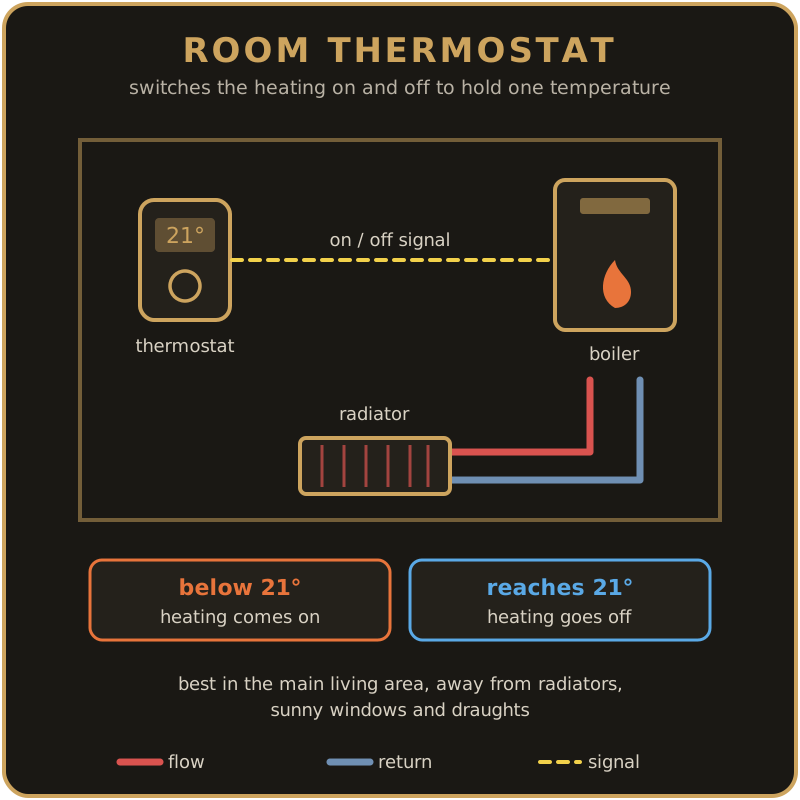
A room thermostat measures the air temperature and switches the heating on when the room drops below the temperature you have set, and off again when it gets there. It works best on an inside wall in the main living area, away from radiators, sunny windows and draughts, so it reads the temperature you actually feel. Turning it up does not heat the house any faster; it only makes the heating run for longer, so set it to the lowest temperature you are comfortable with, usually somewhere between 18° and 21°.
Smart thermostatsHive recommended
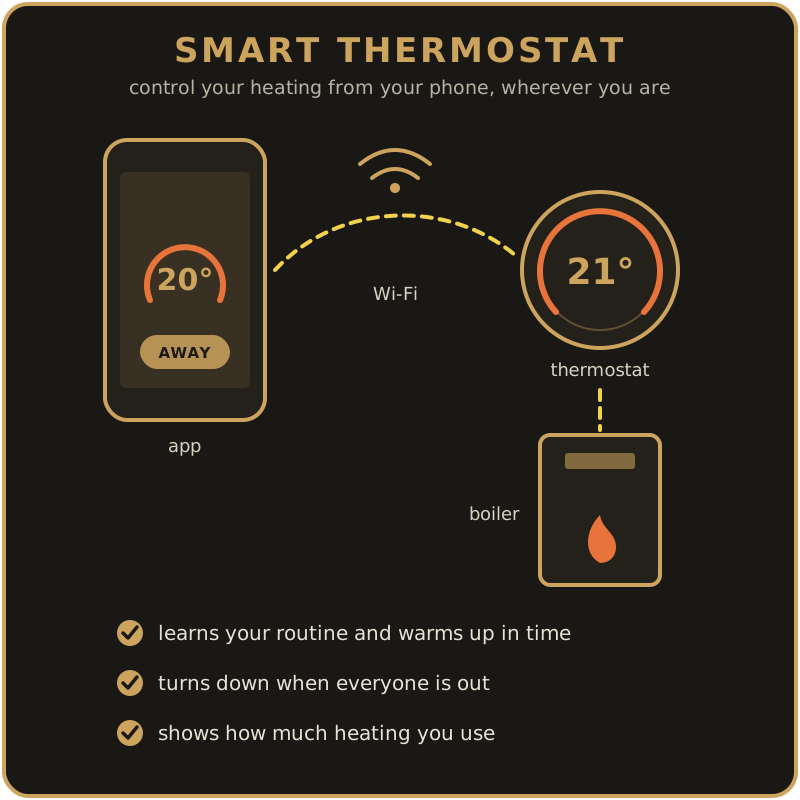
A smart thermostat does everything a programmable thermostat does, and connects to the internet so you can control your heating from your phone: turn it up on your way home, off if you go away unexpectedly, and see how much you are using. Many learn your routine and turn down when everyone is out. Smart controls are also the simplest way to meet the Boiler Plus rules for new combi boilers, and work best with boilers that support “OpenTherm”, which lets the thermostat turn the boiler up or down gradually instead of simply switching it on and off. We recommend Hive, and we still look after Nest systems already in place.
Programmers and timers1 or 2 channels
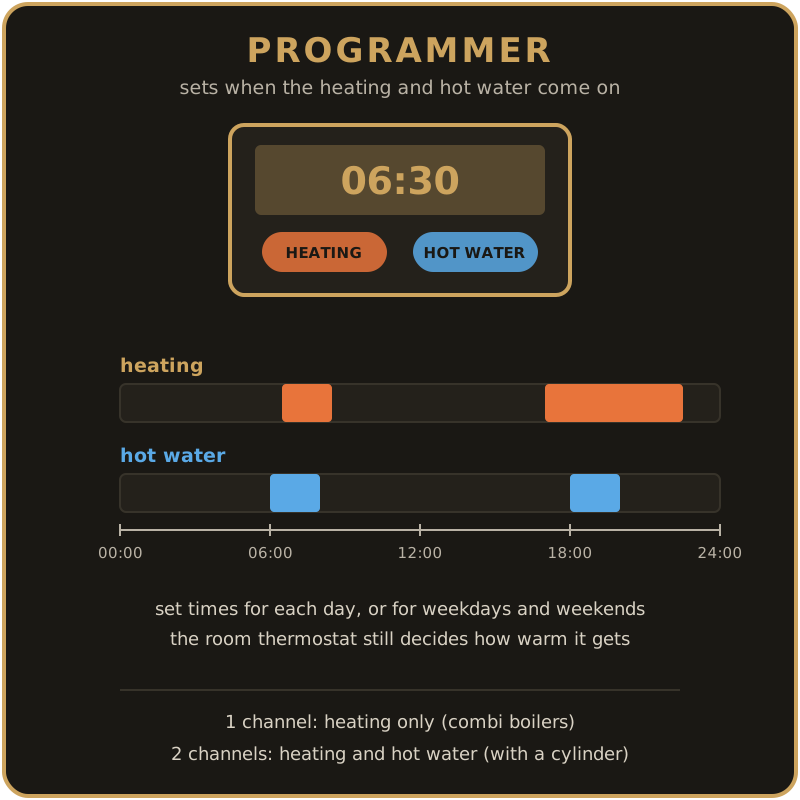
A programmer sets the times your heating comes on and goes off, for example before you get up and when you come home. A combi boiler only needs a single channel for the heating, because it heats hot water on demand. A system or regular boiler with a hot water cylinder needs two channels, so the heating and the hot water can run at different times.
Smart radiator valvesA timetable per room
Smart radiator valves replace the heads on your existing valves and give each room its own timetable, controlled from your phone. They are ideal for rooms you only use some of the time, such as a spare bedroom or a home office, and work alongside a smart thermostat such as Hive.
Programmable thermostatsTime and temperature
A programmable room thermostat combines a thermostat and a programmer in one unit, with different temperatures at different times of day, such as warmer in the evening and cooler overnight. They are often wireless, so the thermostat can sit where it reads the room best.
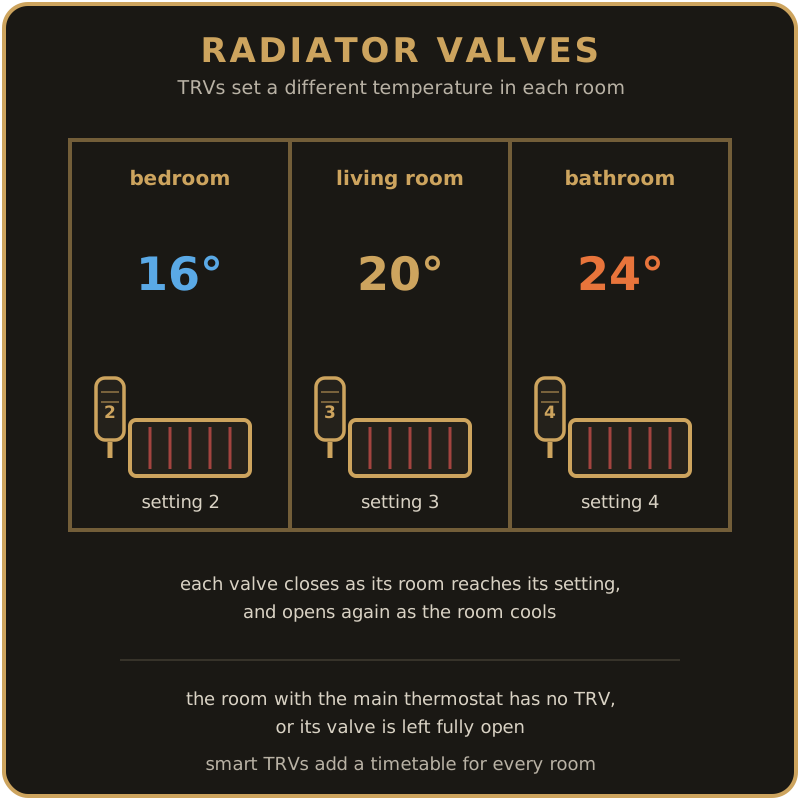
Thermostatic radiator valves (TRVs) sit on the side of each radiator and control the temperature of that room, so a bedroom can stay cooler than the living room. Each valve closes as the room reaches its setting and opens again as it cools. The numbers on the head are not degrees, but a rough guide: 3 is usually about 20°. The room with the main thermostat should not have a TRV, or its valve should be left fully open, so the two don't work against each other.
These controls change how hot the boiler runs rather than just switching it on and off. Weather compensation uses a sensor outside to turn the boiler down on milder days, and load compensation does the same based on the temperature inside. Running at lower temperatures for longer is more efficient and gentler on the boiler, and it is essential for heat pumps. Both count towards the Boiler Plus rules.
Heating zonesUpstairs and downstairs
In a larger home, splitting the heating into zones lets upstairs and downstairs, or an extension, be heated at different times and temperatures. Each zone has its own thermostat and a motorised valve, and we do all the wiring between them and the boiler.
Controls not working?Fault finding
If your heating comes on when it shouldn't, won't come on at all, or never seems to get warm, the controls and their wiring are one of the first things we check. We can trace faults in thermostats, programmers, motorised valves and wiring centres, replace an old dial thermostat or a programmer that is hard to read, and make sure everything works together.